What are the top pitfalls when installing DDecks Composite Decking?
As one of the UK’s leading composite suppliers, we have many years’ experience in the composite and construction industry and have pointed out the most common pitfalls we have come across which can lead to your composite decking not performing as expected and causing issues down the line. Below are the top 10 – avoid these and your composite decking will look good and work well for many years.
1) Substandard or Pre Existing Subframe
As with any construction install, the foundations are probably the most important part. Unlike timber decking, composite decking requires significantly more support. A pre-existing timber deck subframe would not be man enough to do the job and would need to be upgraded with additional joists and any damaged joists replaced. Our decking MUST be fixed to joists at either 350mm (D3 & DuroDual) or 400mm (Duro360) centres. 350 or 400mm centres (dependant on range) 2) Insufficient
350 or 400mm centres (dependant on range)
2) Insufficient Ventilation beneath the Deck
Being a semi-organic material (65% FSC wood), composite decking absorbs a small amount of moisture. We recommend a minimum gap of 35mm between your base, whether it be concrete slab, stone or turf, and the underside of the deck boards. This will ensure that there is airflow and ventilation enabling the timber joists and deck boards to drain and dry completely. This will help stop timber joists rotting. DDecks Protect Tape can also be used on every joist to alleviate even more risk of timber rotting in damp conditions.
3) Insufficient Gaps between butt ends
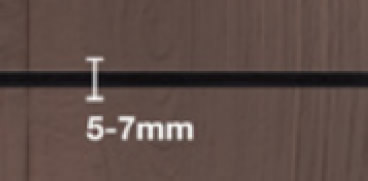
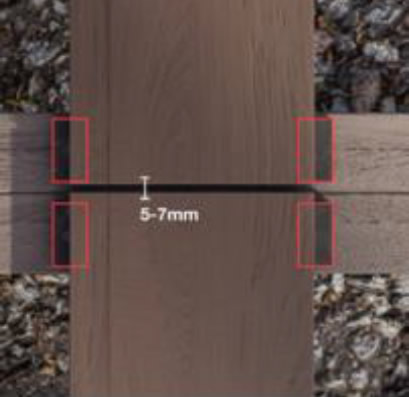
DDecks Composite Decking is manufactured using recycled wood and plastics. This means that it is affected by the elements and weather to a far greater degree than timber. The boards will expand and contract with the change in weather and MUST be installed with a minimum 5-6mm gap to allow for this. If the boards are installed too closely, the expansion and contraction could lead to the boards cracking and splitting with the pressure between the boards.
4) Not using correct fixings
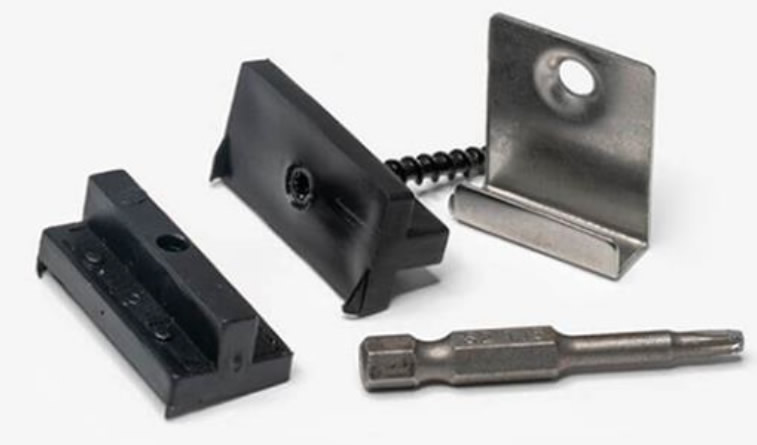
Although our composite has the look of timber, it does not act and cannot be installed in the same way. As experts in our field, we have designed and manufactured our fixings pack to work perfectly with our decking systems. The use of the starter clips and T spacers within this pack will sort the issue of getting the spacing and gaps right and are necessary for the Warranty to be valid.
5) Fixing directly into the decking
Our fixing kits and clips are designed to allow our deckboards to expand and contract with temperature and moisture fluctuations. Screw fixing deckboards may seem like a good idea and make them feel secure – but it is something that will be regretted. Apart from the risk of splitting the boards when screwing directly into them, the boards will push against the screw when they expand a contract leading to cracking, warping, splintering and splitting. Always use the specialist fixings available.
6) Not installing double joists where two joining boards meet
A strong base is a must when installing composite decking. Where a longer length deck (over 3.6m) is being installed, deck boards will need to be butted together (making sure there is a gap between the butt ends!). It is absolutely imperative that these joins are given extra support and installed on double joists to make sure the boards don’t split or crack.
7) Sharing clips between boards
Clips should always be one per board. Where you have butt joints for a larger deck – 4 clips will be needed on the cross-section 2 per board as shown in our online installation guide (image 11). The sharing of clips can lead to the boards warping and splitting as they aren’t sufficiently fixed and the gap will probably be too narrow to allow for expansion and contraction.
What happens when 1 clip is shared between boards
Correct installation
8) Not allowing an adequate drainage slope
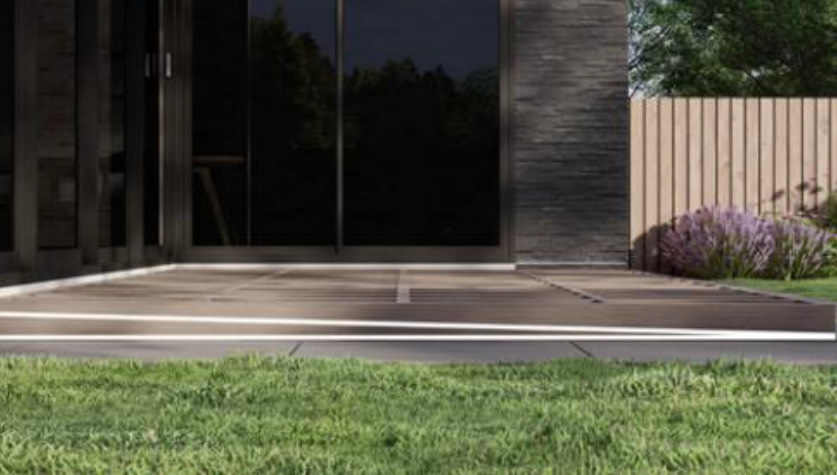
We recommend a slope of 1:100 gradient be allowed for. This will mean that your deck will slope slightly away from your house allowing water to drain naturally away and remove the risk of pooling, slippery surfaces and rotting of the subframe.
8) Not allowing an adequate drainage slope
Not all Composite Decking boards are the same. DDecks have 3 in the current range. All are products and premium quality sourced using sustainable materials and ecologically friendly manufacturing processes, and all with slightly different looks, colours and attributes. D3: With its deep embossed woodgrain design, this range is the most realistic wood effect on the market. The deeply textured grain mimics the subtle variations in colour changes and patterns seen in natural wood and we are meticulous in ensuring no two boards are the same. Manufactured with the texture embossed directly within the surface of the boards – the D3 is a premium product and is suitable for all applications from home gardens to city developments, parks, swimming pool areas, holiday parks or podium deck spaces. DuroDual: Our most cost-effective, low maintenance range gives a choice of two finishes. A reversible board with a wood-effect texture one side and the traditional ‘grooved’ deck effect on the other, the DuroDual is manufactured using the same process and materials as all our products. Suitable for residential and commercial projects, this range is a good choice for many applications.